History and References
SE1 Newspaper
The local news that other papers did not print
SE1 was one of the longest-running of the numerous radical community newspapers that emerged throughout the UK during the 1970s and 80s. The collectively run paper focussed on the London neighbourhoods that stretch along the south bank of the Thames from Waterloo in Lambeth to Tower Bridge in Southwark. It was launched in July 1975. It had its ups and downs over the years but survived, serving the area until early 1991.
Origins
The 1950s and 60s had brought massive change to the residents of Waterloo and North Southwark. Whole industries such as food processing, the wharfes, engineering, brewing and more disappeared leaving empty lots and derelict factories. Then in the early 1970s the developers arrived promising rejuvenation - but for whom?
Not for the families who had worked and lived there for generations. Offices and hotels sprouted everywhere while the local needs for more low cost housing, more open space and better services were ignored. You had to walk a long way to get to a chemist. Some of the housing still included flats where neighbouring families had to share bathrooms located on the landings.
Whoever controls the news controls the story
In their fight to rejuvenate their area, stop office development and build housing, the residents of Waterloo and North Southwark decided they needed their own newspaper. Mainstream media such as the South London Press were not telling the full story of the development threats from the residents' point of view nor were they covering their campaigns or other events in their neighbourhoods.
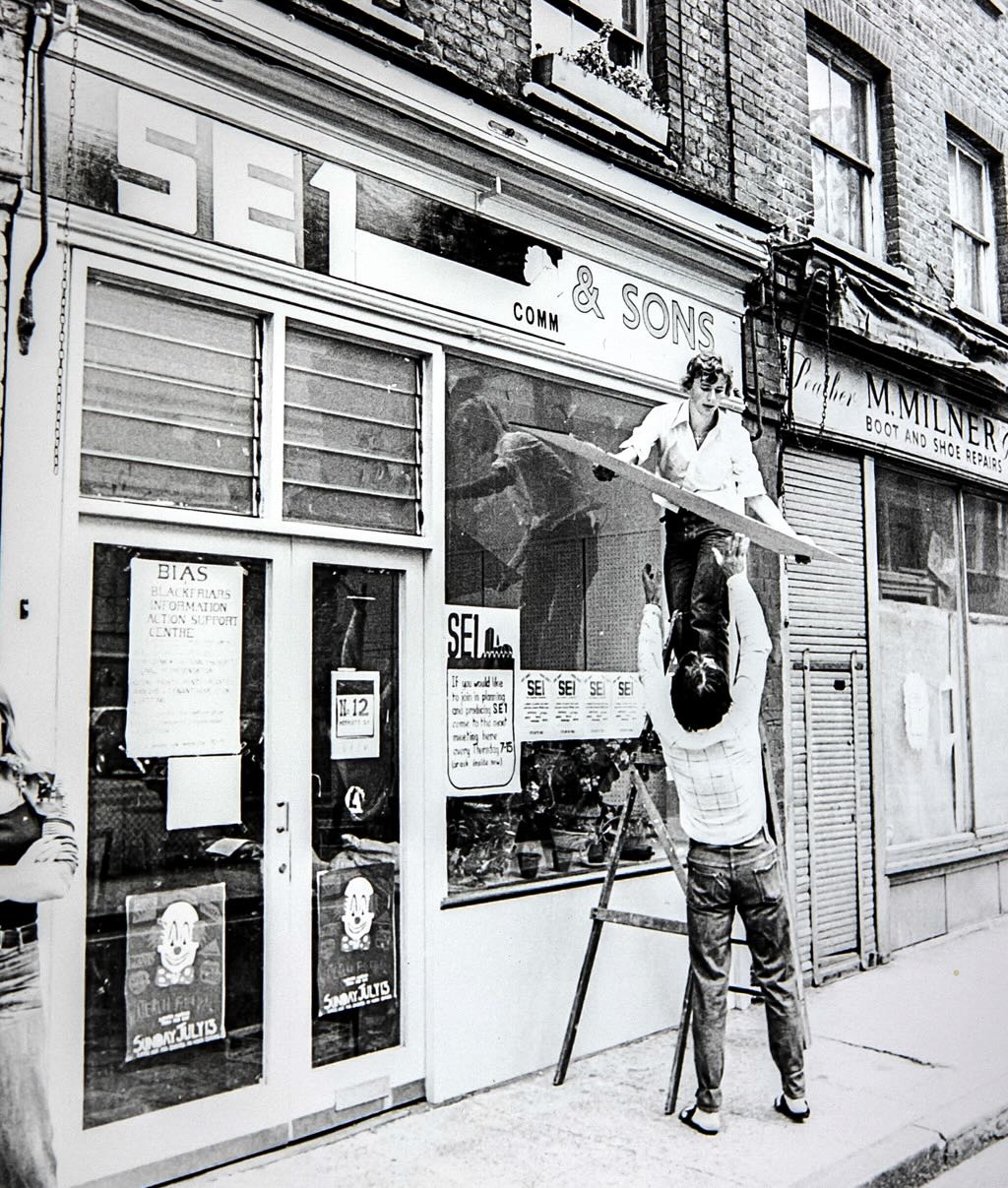
SE1 office shopfront sign goes up in Meymott Street at the begiinning of the project in 1975. Photo courtesy of Southwark Archives
The Blackfriars Community Action Team, the North Southwark Community Development Group (NSCDG), and local residents came together to found SE1 community newspaper. They set up office in some disused shop fronts in Meymott Street, SE1. Their aim was to share news among residents about their neighbourhoods and mobilise them to join campaigns to improve local conditions, protect local jobs and provide better housing and services.
While organisation and drive made SE1 a success, the project could not have succeeded without certain historical conditions being in place at that particular time too.
Offset, Printshops, and Paste-up
Through the 1960s cheap offset printing and simpler page layout methods triggered an explosion of independent printers and publications. Offset lithography had its beginnings well over a century ago, but it wasn't until the late 1960s that it had matured to a point where it became significantly cheaper compared to traditional letterpress systems.
Sheet fed offset printers offered some savings but it was the web offset machines which could print at high speeds on large rolls—or webs—of paper, often on both sides of the paper simultanously, using in-line printing units and in-line finishing systems that were ideal for newspapers and considerably cheaper.
Skills for preparing text and page artwork had become easier too using the paste-up method of layout - the key word being "easier" rather than "easy". Starting a newspaper still involved huge commitment and a steep learning curve.
The first series of SE1 was printed by the charity and campaigning organisation War on Want. Later issues were printed by radical print shops Spider Web Offset and East End Offset.
How was it produced?
With much effort! The paper was entirely put together by volunteers who researched and wrote the articles and took the photographs. Pasting up the layouts for eight, ten or sometimes twelve pages got faster with pratice but, even so, was fiddly and labourious.
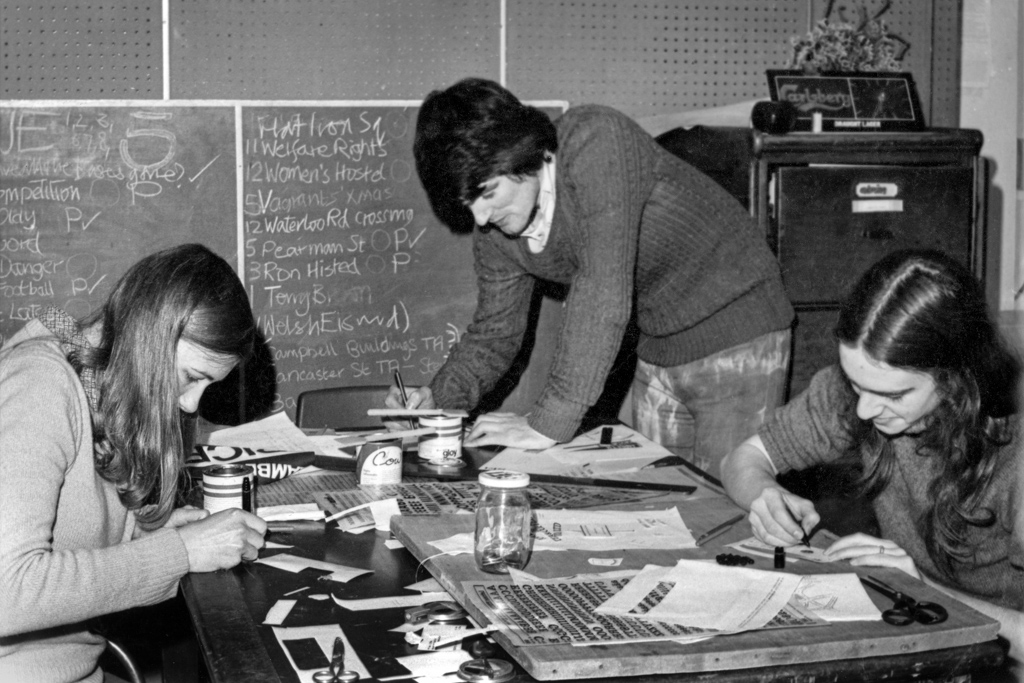
Photo courtesy of Southwark Archives
To save money, the text for the articles was typed out in columns using an old-fashioned typewriter instead of having the text typeset at the printers. The columns of text were then trimmed to fit the column guides on the page size layout sheets and pasted down using a highly "aromatic" rubber cement called Cow Gum.
The stuck down text could be made to fit or corrected by using a scalpel to cut out words, lines or whole sections, then peeling them off the layout sheet (Cow Gum didn't dry hard) and pasting the required text back into correct position.
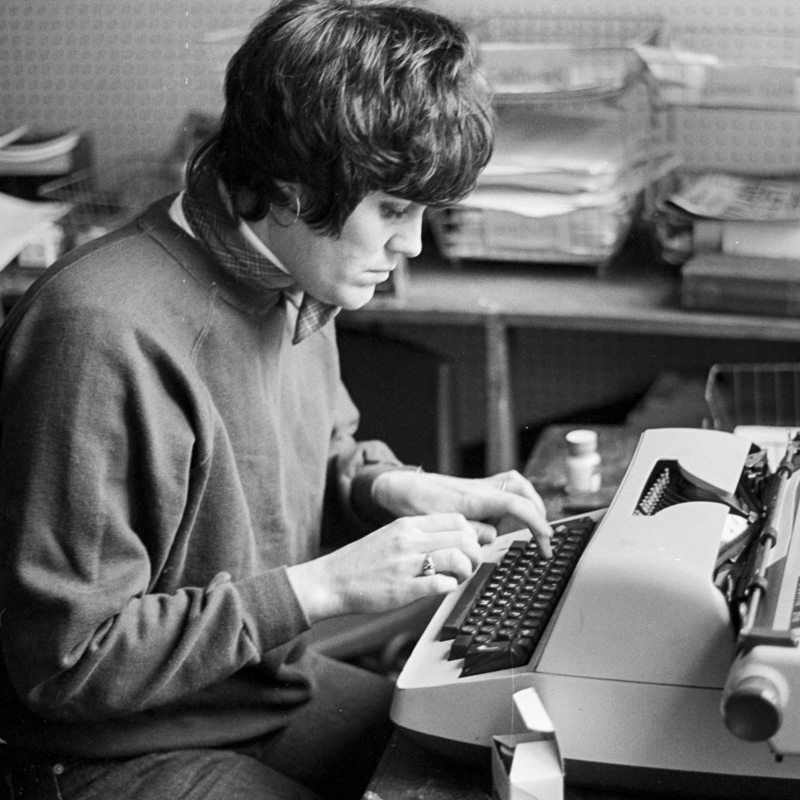
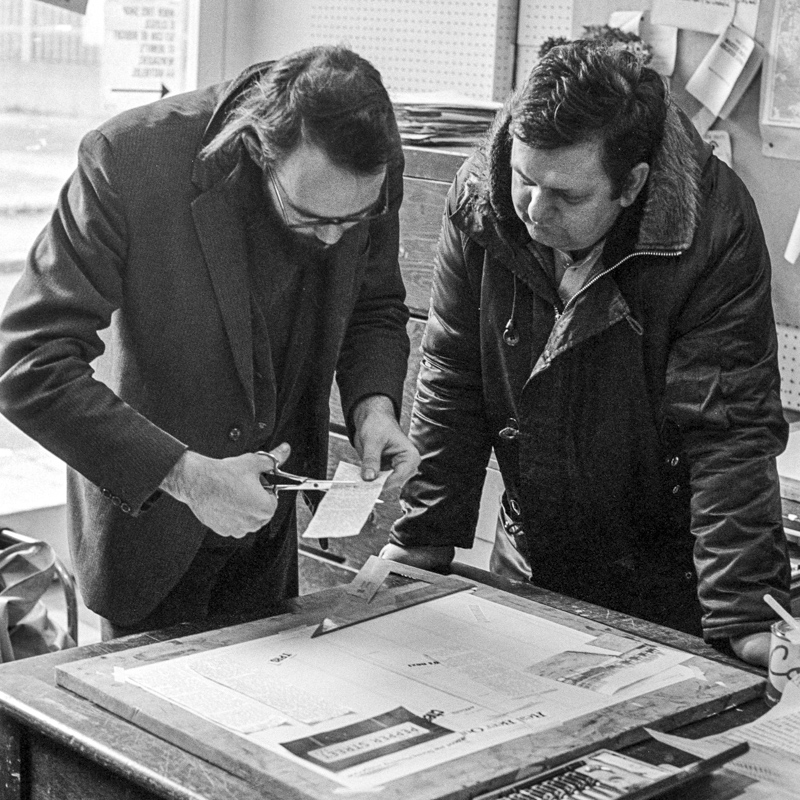
Photo courtesy of Southwark Archives
Headlines were made using Letraset dry transfer lettering. You rubbed letters from transparent backing sheets onto paper then trimmed and glued the headline to the page. Every headline had to be individually produced in this time-consuming way, letter by letter while keeping the alignment and spacing correct.
Headline typefaces in SE1 were often inconsistent. By coincidence the SE1 offices were just around the corner from the Letraset factory. Letraset gave SE1 rejected or outdated sheets for free, but it meant that there were not always enough letters to use across all the pages!
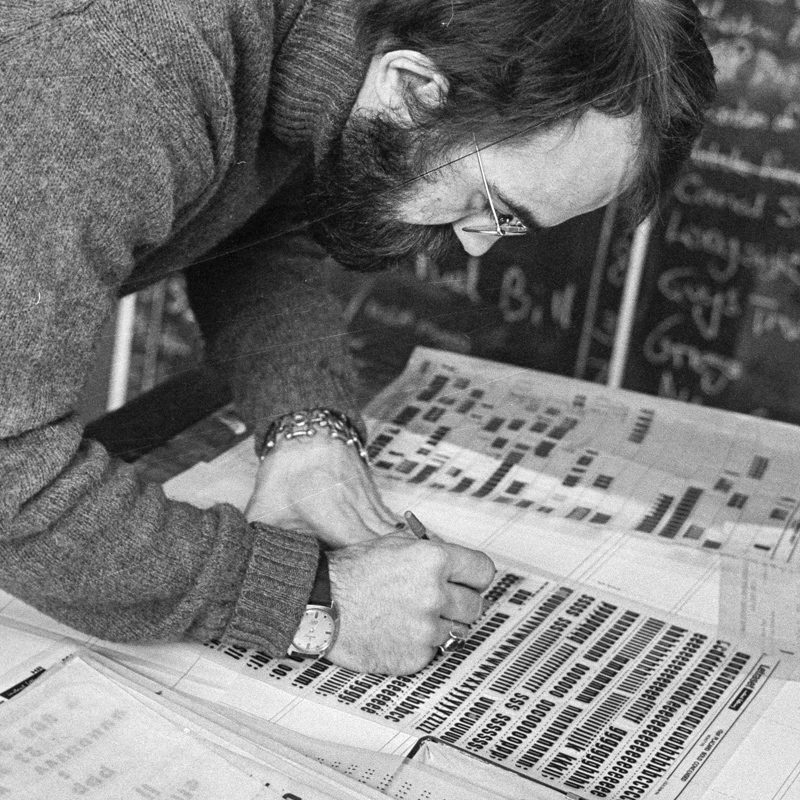
Photo courtesy of Southwark Archives
Photographs were selected and sent to the printer who made halftone copies of them according to the cropping and sizing instructions written by the SE1 team on the backs of the prints.
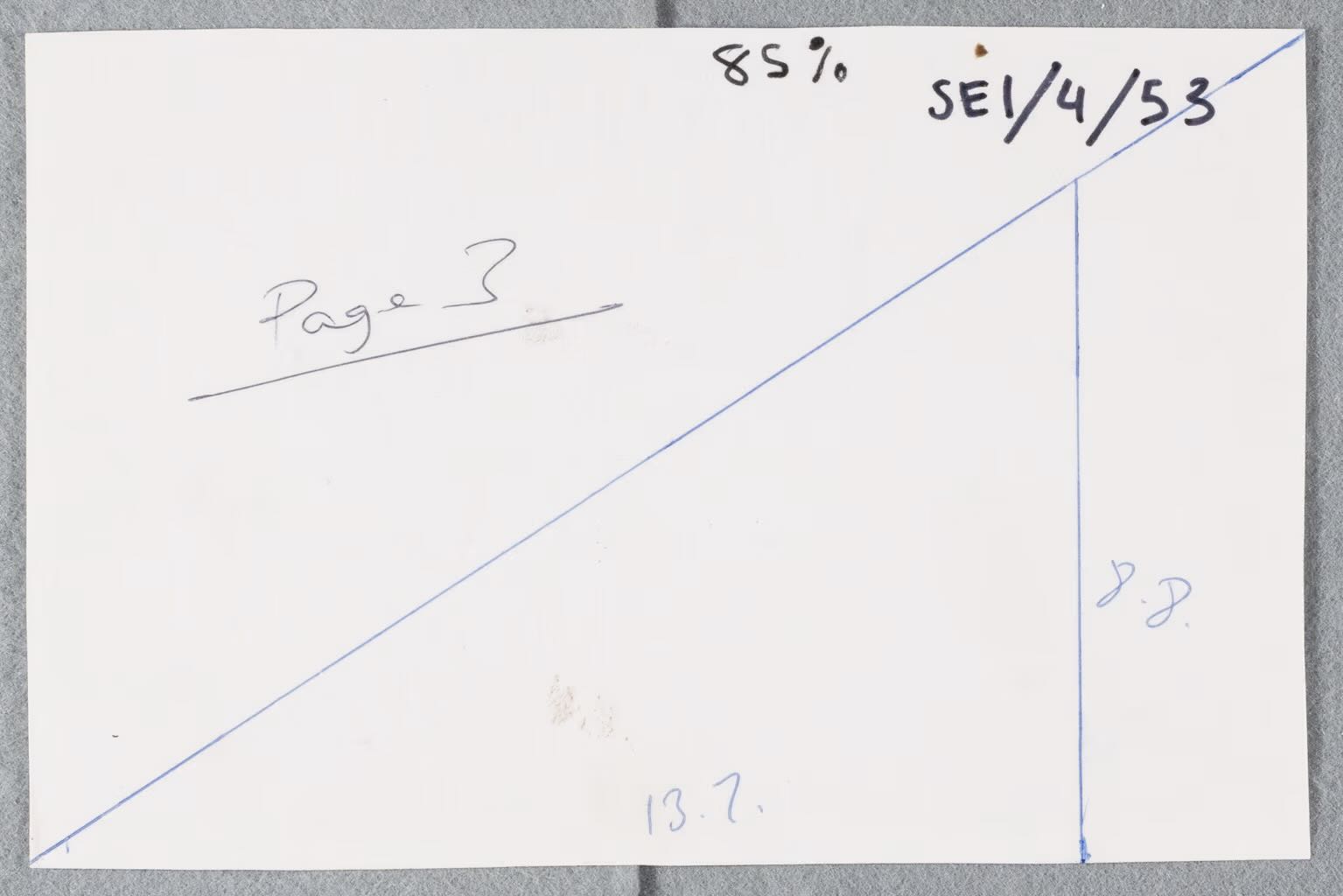
Different printers preferred different ways of marking up what size the image needed to be on the page. Page numbers were also needed with a, b etc added if there were several photos on the page. Photo courtesy of Southwark Archives
The half tones were made by photographing them through a screen or, later, by scanning them electronically. The printer then pasted them into the page layouts. Fingers crossed they ended up in the right place on the right page.
A typical print run was 1500 to 2000 copies. Papers went to newsagents, pubs and cafes and local organisations like tenants’ groups and pensioners’ groups. Newsagents generously gave free space to the paper in support of their community. Some people had their own distribution rounds in their neighbourhood.
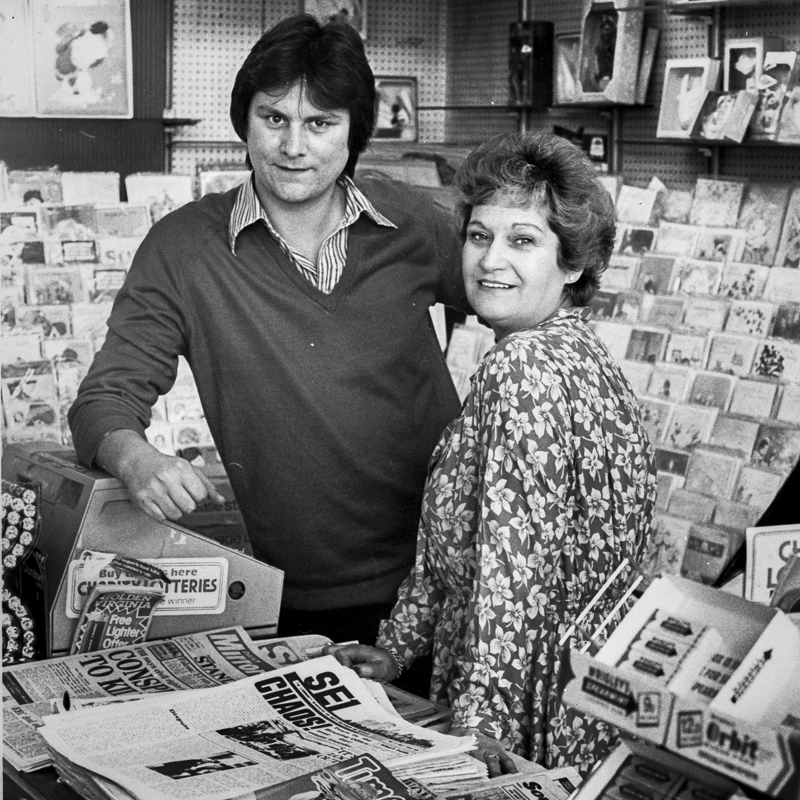
Jacky and Barry ran Stricklands newsagents. It was established more than 100 years ago, originally in Blackfriars Road but moved to The Cut in about 1960. Stricklands was selected SE1 Newsagent of the month in June 1980. Photo courtesy of Southwark Archives
Finance
Advertising helped keep the paper going but through most of its history the cover price mattered too. At first it was 5p, but this crept up as the group struggled to cover the printing costs. There were fundraising events – including, two years running - a sponsored bike ride to Brighton, and a very successful music event in the Colombo Street Centre. In 1977 the cover price was 8p and by July ’79 it was 10p.
Death and revival
The March 1981 issue announced that it was to be the last – not because of money, but because there were not enough people to produce and distribute it.
Local residents and community groups quickly got together to revive the paper. Morley College funded a weekly evening course covering all aspects of production. The GLC gave an equipment grant for a typewriter, camera, handheld cassette recorder, and a new-fangled machine to punch out headlines.
With all these preparations completed, SE1 reappeared in December 1981, price 15p. In 1984 new funding made the paper free. In 1985 the paper moved to the NSCDG's office in Copperfield Street, SE1. More about SE1 offices later. . .
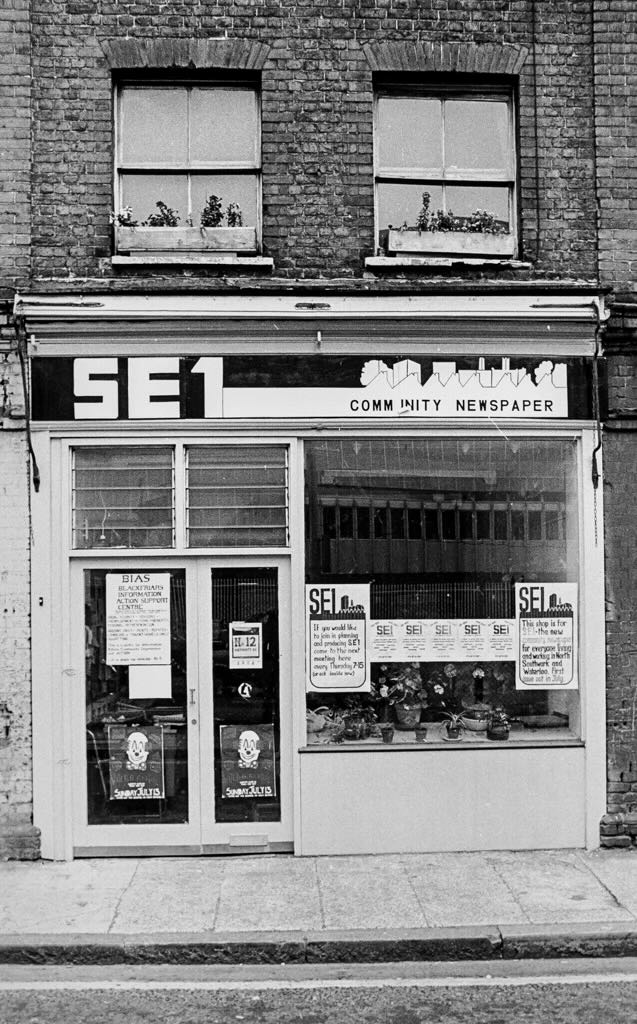
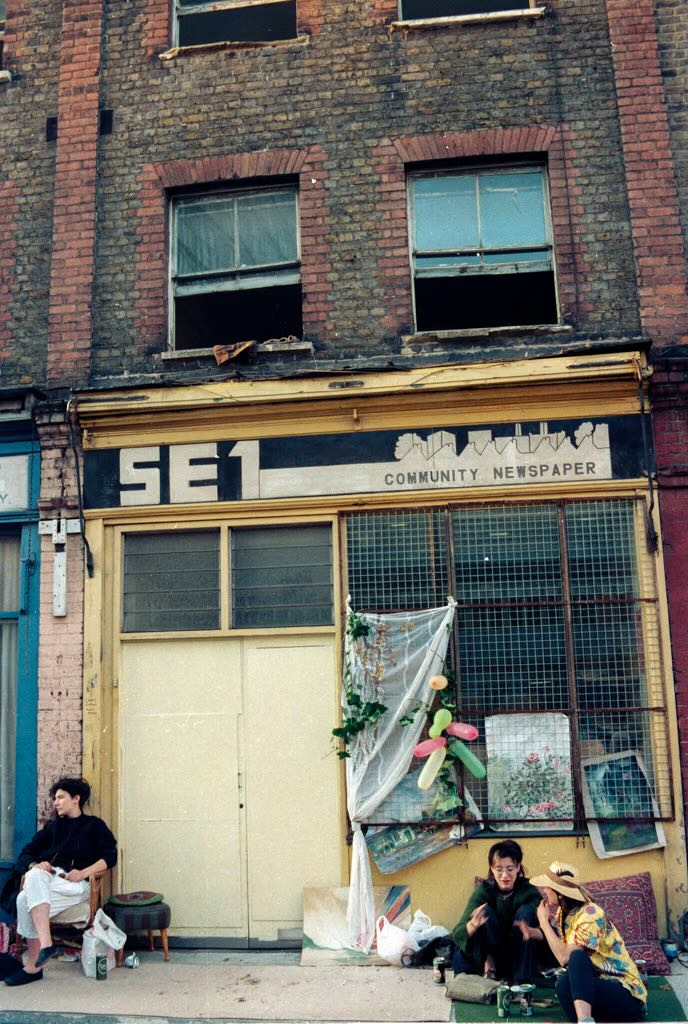
Views of the Meymott Street office: newly opened in 1975 and the farewell party in 1985 prior to demolition. Photo courtesy of Southwark Archives | 1985 Photo by John Howes
SE1 managed to continue until February 1991. By that time it was partly dependent on one of the paid workers at NSCDG to act as effective editor. Other duties began making it impossible for him to continue in this role and there were no volunteers able to take the responsibilities over.
Printing costs were getting higher and higher too, so publication had to cease - a sad reflection of the times since it was low printing costs over a decade before that made it possible to conceive of publishing a monthly newspaper.
Legacy
SE1 did not disappear completely. Southwark Archives had been collecting issues of the paper through all the years it was published which they later bound. In 2018 they aquired a large number of photographic prints, negatives and other material connected to the newspaper.
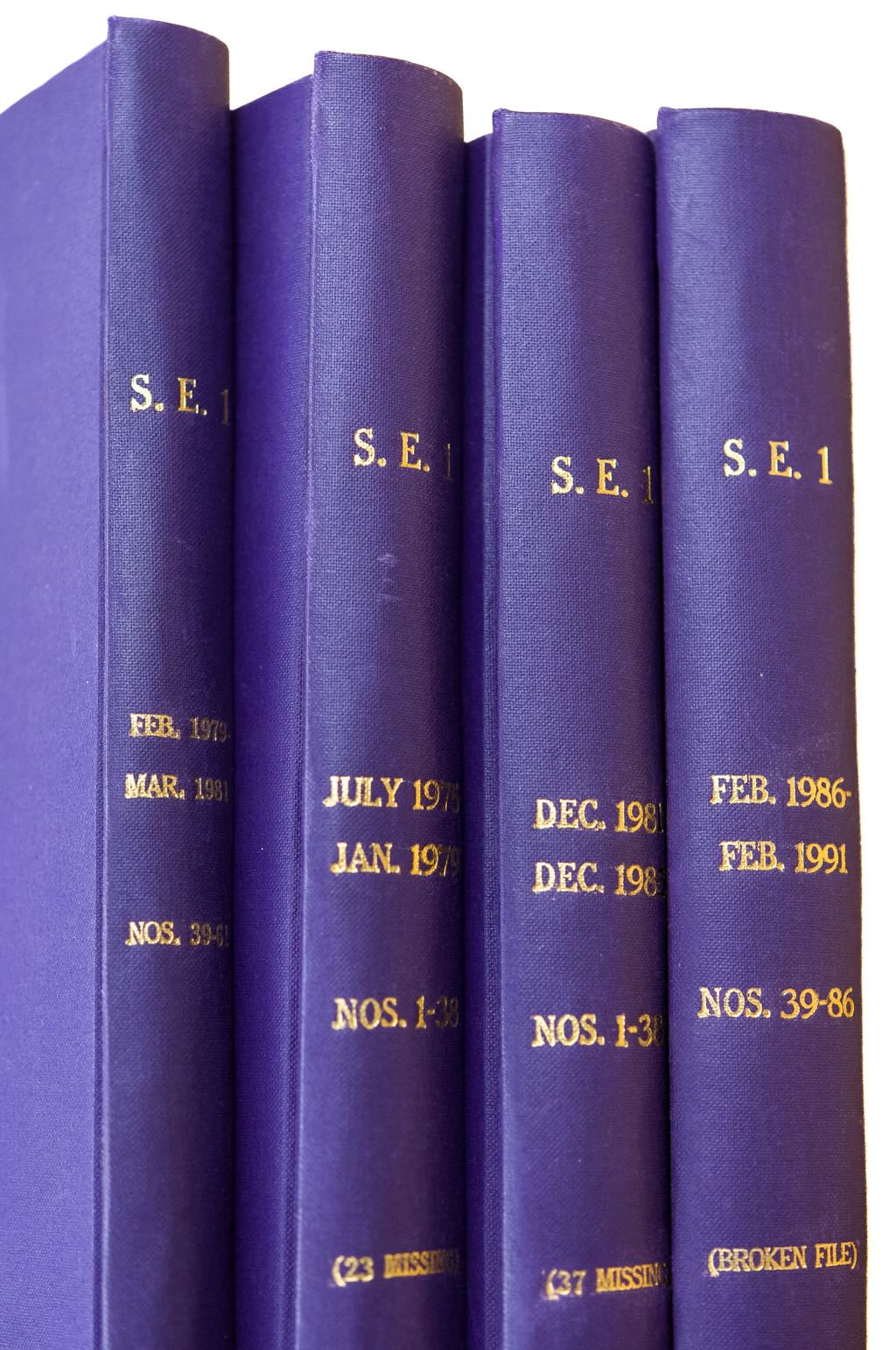
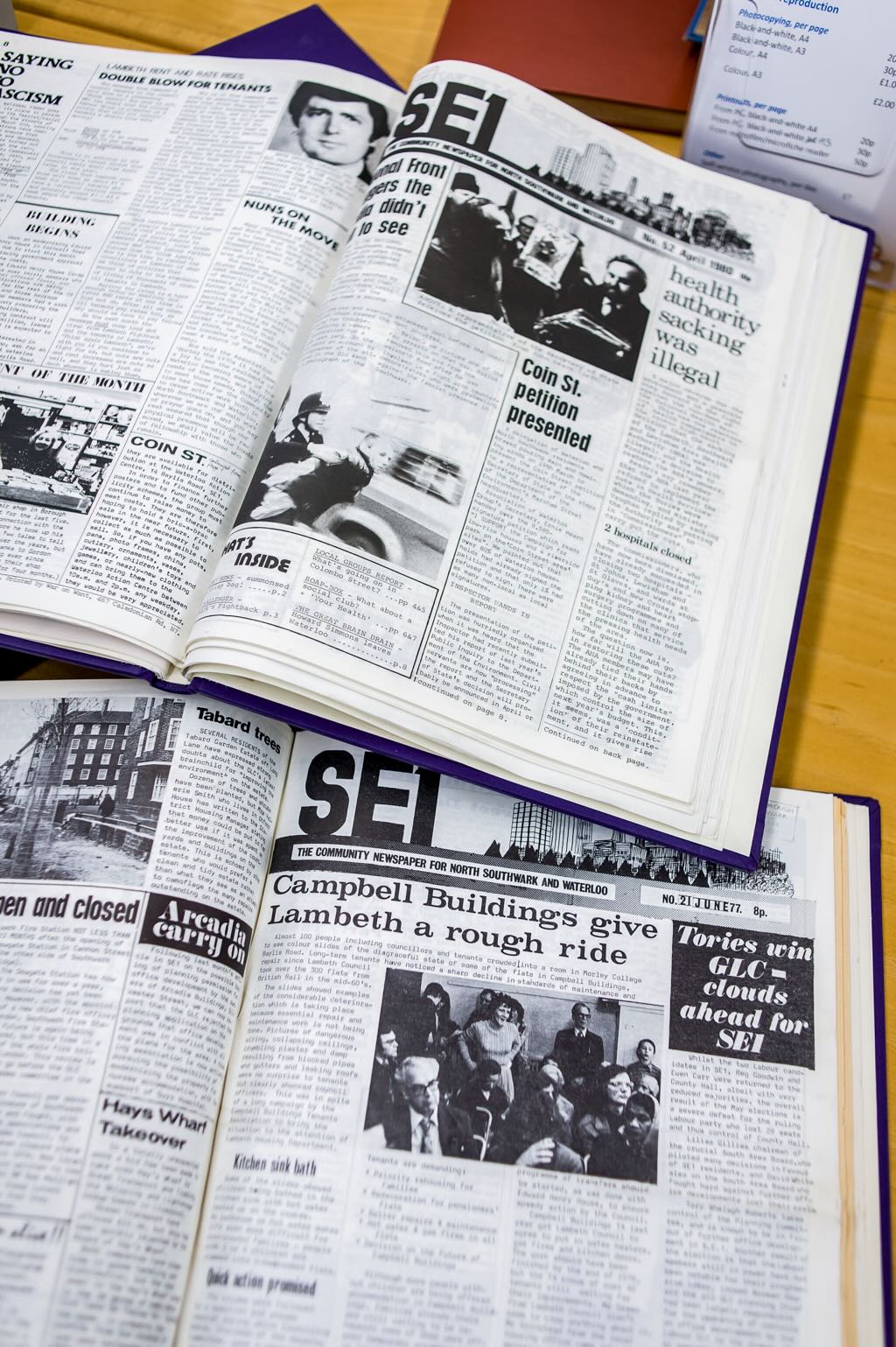
The history of the photo hoard is a little hazy. We know that some material was rescued [this link needs to be cleared by Sally Lynes] from the Meymott Street offices right at the last minute before they were boarded up in 1985. We know that the set given to the Archives came from the Willowbrook Urban Studies Centre when it closed in 2018. We are not sure if the material went directly to the Centre or if it was taken to the NSCDG offices in Copperfield St. until those office closed in ???? The 2018 donation includes photos from late editions as well as early editions, which points to the photos from Meymott Street going to the NSCDG. [Bob and his wife Deb are going to clarify some of this timeline].
Meanwhile, not far away, Lambeth Archives had been holding a related set of photos since 1994, many of which had appeared in SE1. The Blackfriars Photography Project collection was donated to Lambeth Archives when the project came to an end after 22 years.
In 2019 the collections in both archives caught the attention of a former photographer coordinator of the Blackfriars Photography Project. Her discovery led to other SE1 contributors meeting up and forming the SE1 Stories group.
The group are mainly focussed on the Southwark Archives collection of newpapers and photos at this point. We are trying to identify people and events in the photos and getting everything ready for the online archive Southwark Library are developing. We have also been finding ways to get the images out into the local neighbourhoods, partly for feedback, partly to share the social history they encapsulate, and partly to support the work of local activists today.
During the COVID lockdown, we were given a grant by Southwark Council's Blackfriars Stories fund to create a touring exhibition celebrating the roles that SE1 newspaper and other social-action projects played in community action campaigns in the 1970s and 1980s, and how those efforts connect to contemporary debates. We had to curate and design it through meetings on Zoom. The exhibition has had nearly 30 showings over four years in local community centres, leisure centres, libraries and church halls. It includes a number of artefacts, including replicas of SE1 newspaper issues, shown below.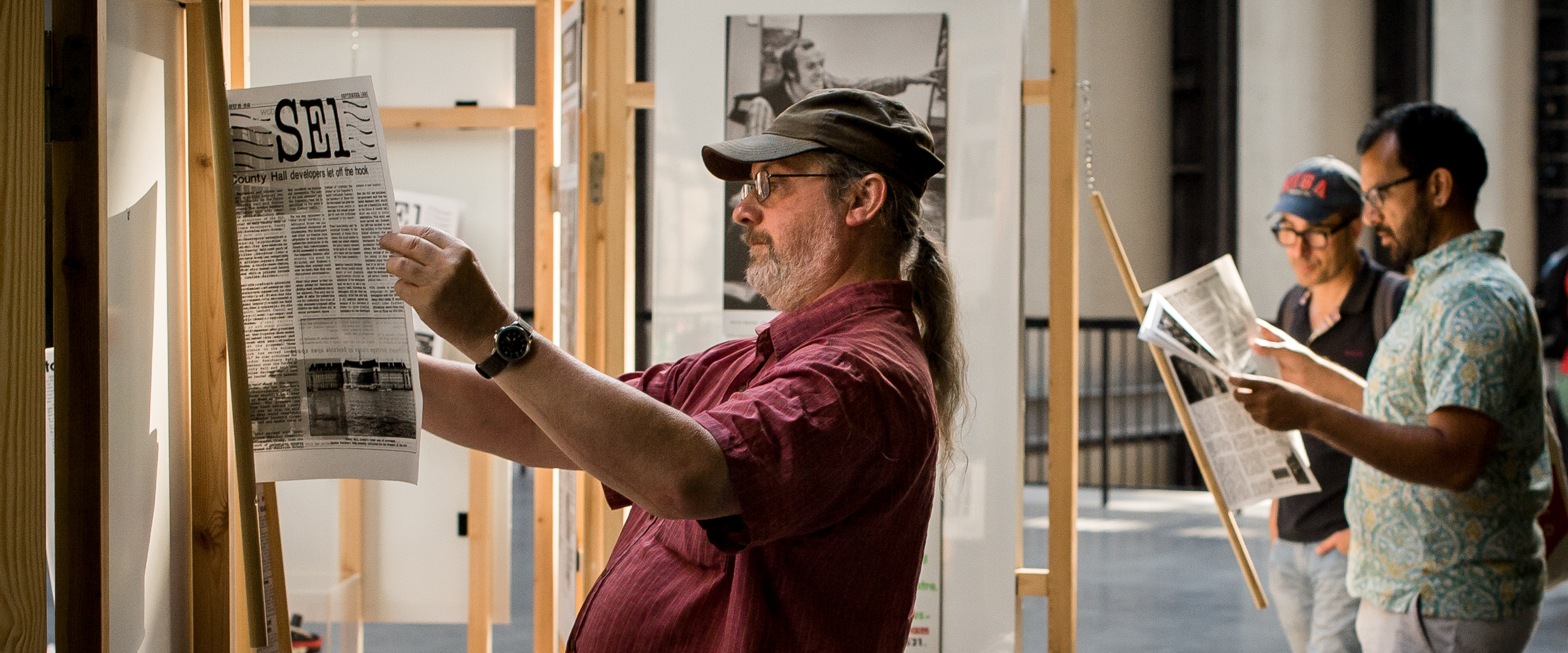
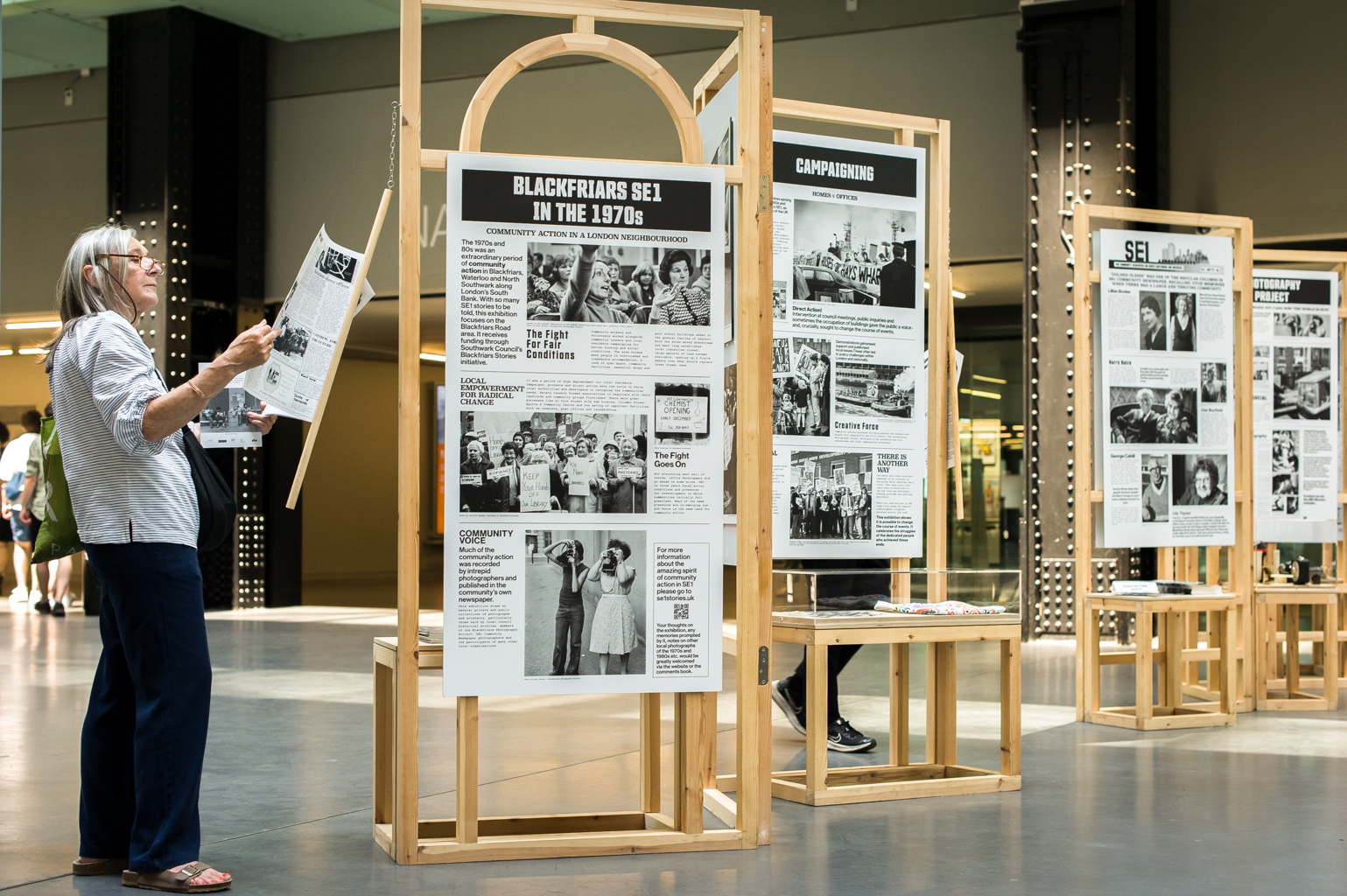
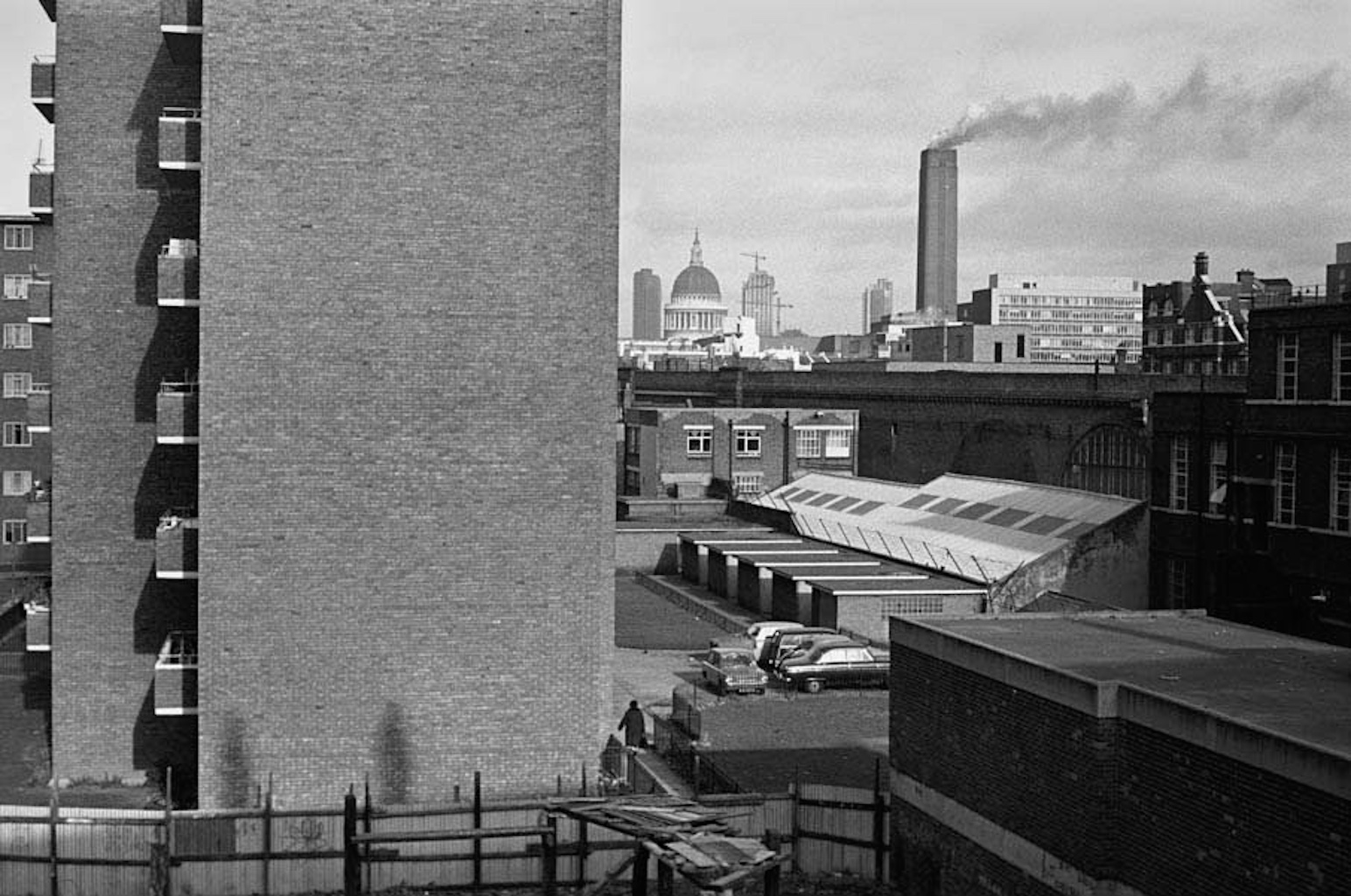
Replica SE1 newspapers feature in the SE1 Stories touring exhibitiion, shown in the top two images during its time at the Tate Modern. The bottom image shows how what we know as an internationally respected art gallery was then still the Bankside power station. SE1 covered its closure in 1981 and followed the debate about what to do with it afterwards. Photos by Paul Carter
We have also managed to raise funds for digitising the newpapers and photos in the SE1 collection, making this site possible and laying the foundations for an online picture library.
Offices
SE1 newspaper was initially produced from some abandoned shops awaiting redevelopment in Meymott Street off Blackfriars Road. Some of the newspaper's volunteers, members of the Blackfriars Community Action Team, lived in the flats above the shops for several years with the agreement of the owner. Eventually, in 1985, the site was repossessed and redeveloped into an office block.
In its final years the newspaper was produced from the offices of the North Southwark Community Development Group in Copperfield St.
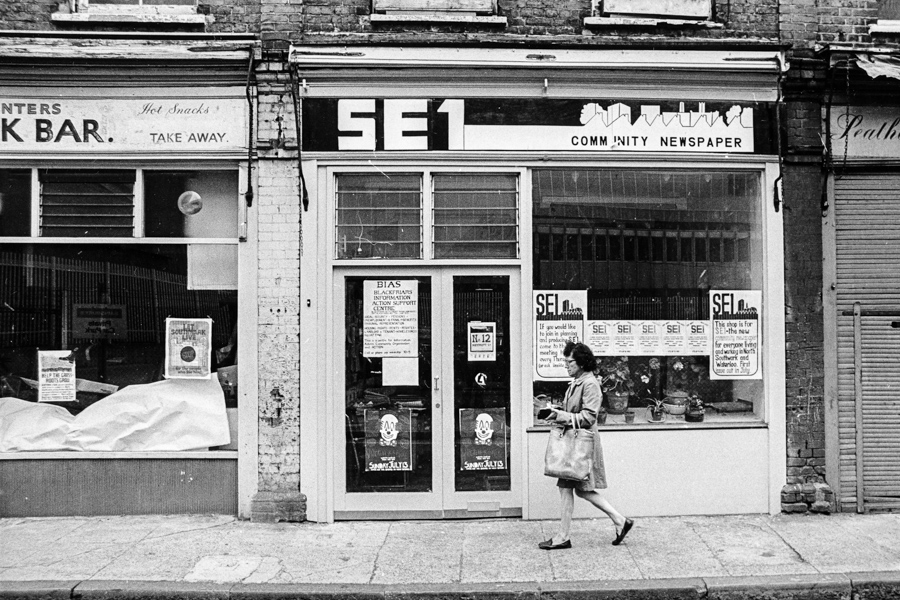
The SE1 newspaper office in Meymott St, SE1 (1975-1985). Photo courtesy of Southwark Archives
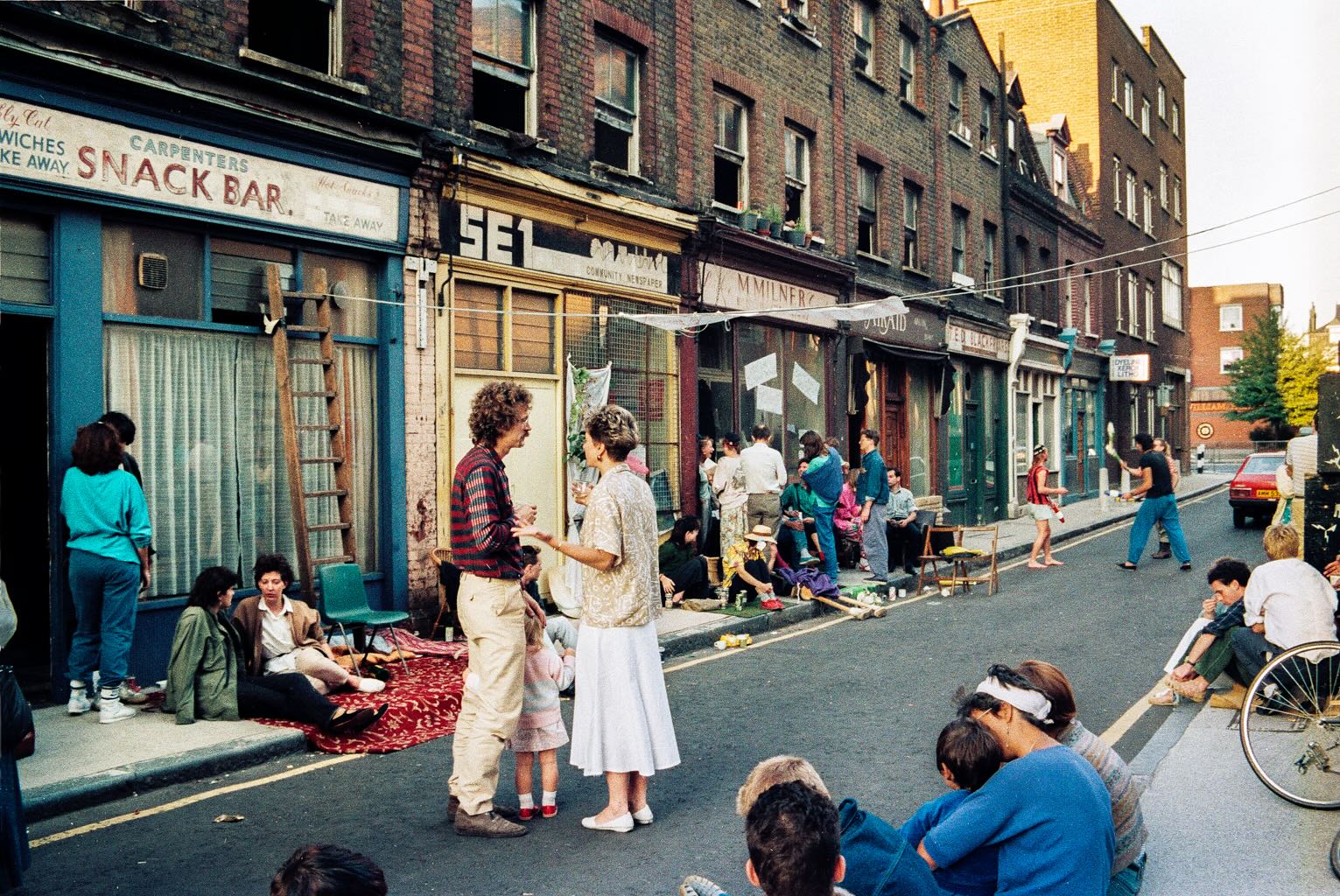
Farewell party for the Meymott St offices in 1985 before they were boarded up and eventually demolished. Photo by John Howes
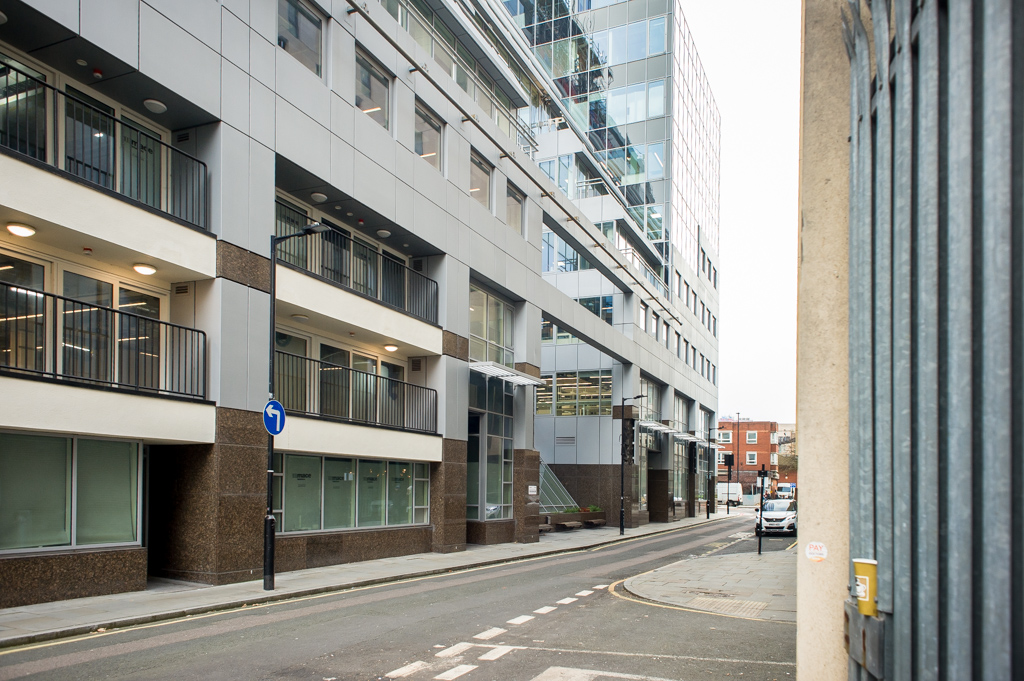
Meymott St. after redevelopment Photo by Paul Carter
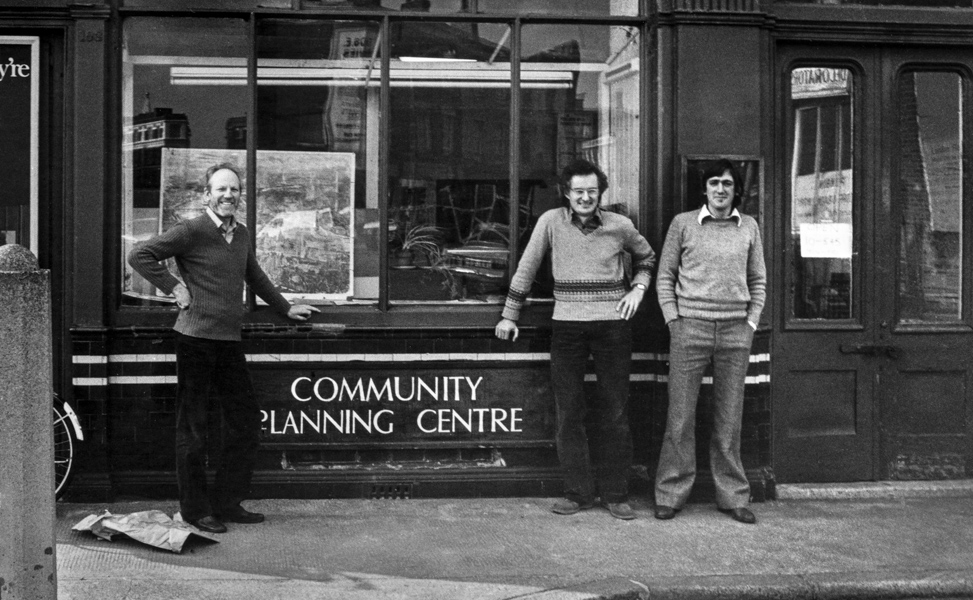
In ???? SE1 moved to the North Southwark Community Development Group office in Copperfield St, SE1. George Nicholson (on the right) effectively became its editor. Photo Courtesy of George Nicholson
References
Community Printshops and Publishing
The combined advantages of lower costs and simpler production methods that web offset printing introduced during the 1960s democratised publishing. It made it possible for small independent organisations with low budgets to publish short run newspapers, giving a voice to people and issues normally marginalised or ignored by mainstream media.
These publications are usually referred to as the radical, alternative, underground, anti-establishment or community press. They were the social media of their time. Most folded after a few years, some lasted a decade or more, but interest in them has not disappeared. They are increasingly the subject of archiving projects and historical studies. We have listed references to some of them below.
Community Photography
It is hard to mention radical publishing without also mentioning the parallel growth of community photography projects during the 70s and 80s too. They often worked in tandem with community publishers taking photos for them, teaching volunteers how to take pictures themselves or sharing cameras and darkroom facilities, in a context that encouraged exploration of identity and community. Many social documentary photographers were community focused too, and contributed to community and independent publishing.
SE1 collaborated (particularly in its earlier years) with the Blackfriars Photography Project (1972-1994) based at Blackfriars Settlement just a short walk away from the SE1 office.
Find out more using the links below.
Radical Publications and Printers 1960s to 1990s:
Archives
The Papers, a list of local radical papers, published by Recovering the Regional Radical Press in Britain 1968-88, a project based in the Regional History Centre at UWE Bristol
Radical and community printshops, list of past and contemporary printshops initiated by Jess Baines’s research project
Underground and Alternative Press Collection, collection of underground magazines written in the sixties, seventies and eighties in the UK, including Brighton, is available on microfilm, University of Brighton; also see the PDF of original research The Underground and Alternative Press in Britain - A Bibliographical Guide with historical notes by John Spiers, pub.ished by The Harvester Press (1974)
Radical Brighton, Alternative/Left/Freak/Radical/Hippie etc, local papers
Liverpool Free Press Archive
Muther Grumble Archive “the North Easts Alternative Newspaper”
Hackney People’s Press
Mole Express, Manchester Digital Music Archive
The Alternative News Story - Follow the journey of Black press during the 1970s to 1990s, Black Cultural Archives
Community Action Magazine (1972-1990), SPACES OF HOPE: the Hidden History of Community Led Planning in the UK, People’sPlans.org
Alternative Press, 1970s, list of publications held by LSE (London School of Economics)
SE1 Community Newspaper, Internet Archive: online copies of the bound set of SE1 issues held by Southwark Archives, posted by Southwark Archives
SE1 Community Newspaper, Internet Archive: online copies of the issues missing from the bound set above; posted by Southwark Archives
SE1 Community Newspaper: website and online archive of all SE1 issues with historical background of the newpaper, created by SE1 Stories in collaboration with Southwark Archives
The 1970s: Alternative Press, University of Illinois, USA
Underground/Alternative Newspapers History and Geography, MAPPING AMERICAN SOCIAL MOVEMENTS PROJECT (USA)
Alternatives Library Collection, Salem State University (USA)
Articles, Blogs, Reviews and Theses
Democratising Print? The Field and Practices of Radical and Community Printshops in Britain 1968-98, abstract by Jessica Baines (2016), London School of Economics
London's radical printmaking workshops of the 1960s and 70s, by Jess Baines, published by Libcom.org
The freedom of the press belongs to those who control the press: The emergence of radical and community printshops in 1970s London, by Jess Baines, published by Academia.edu
Recovering the Regional Radical Press in Britain 1968-88, University of West England, Bristol project to record small, co-operatively produced local papers; see articles on the site about Liverpool Free Press; Croydon’s Suburban Press; Oxford’s Back Street Bugle; Notting Hill’s Ned/Nell Gate; Crest Press in West London; Bristol Voice; Cwmbran Checkpoint; Bath Minority Press Group’s Here is the Other News; York Free Press; The Moseley Paper.
THE PEOPLE’S PAPERS: EXPLORING GREATER MANCHESTER’S ACTIVIST NEIGHBOURHOOD NEWSPAPERS FROM THE 1970S; WRAPPING UP THE PEOPLE’S PAPERS PROJECT, Working Class Movement Library, Salford; The People’s Papers: Revisiting 1970s Manchester, Manchester Histories blog and video
The History of Radical Community Media, Greater Govenhill
Another world is possible: Aberdeen People’s Press and radical media in the 1970s, exhibition review by the Association of European Printing Museums (2021)
Underground newspapers: The social media networks of the 1960s and 1970s, Days of Rage (USA)
Alternative Local Press (United Kingdom), chapter from the book Encyclopedia of Social Movement Media by Tony Harcup, published by Sage
Community Photography:
Photography of Protest and Community: The Radical Collectives of the 1970s by Noni Stacey, published by Lund Humphries (2020); LSE review
Four Corners Archive - Community photography references - Community Photography in the 1970s talk
Community and Representation: Empowerment, Activism, and the Image - 1970–90, Abstract, Oxford Academic, 2020
Photography for Whom?, edited by Anthony Luvera
Community Media. Community Communication in the UK: video, local TV, film, and photography - A documentary report on six groups by Heinz Nigg and Graham Wade, published by Regenbogen Verlag, Zürich/London 1980, ISBN 3-85862-010-6; text available in full online here.
How Change Happens: Photography, Education and Society, by May McWilliams, self-published via Blurb.com, 2020
Blackfriars Photography Project collection - Lambeth Archives
Explorations: collections by and about women at Lambeth Archives - Art and Photography
North Paddington Community Darkroom collection, Bishopsgate Institute
Our Faces, Our Spaces, Photography, Community and Representation - out of print book, edited by Judy Harrison, published by John Hansard Gallery (2014).
Contemporary Photography as Collaboration, edited by Mathilde Bertrand, Karine Chambefort-Kay, published by Palgrave MacMillan (2024)
British Culture Archive
Radical printshops, community publishing and community photography were in turn part of an even wider movement of all kinds of arts and media initiatives through the 70s and 80s. Commmunity arts and media projects from the 1970s and 80s such as poster workshops, community theatre, carnivals, community video, murals, music, gardens and writing groups, flouished.
The Arts Council and local arts funders came on board with the idea that arts and media needed to reach wider audiences, be practised by a wider range of people and be better understood for their value at a personal level and for fuelling social engagement and democtratic change in partnership with grass roots activism by raising voices not normally heard through mainstream arts and media.